Tuesday, September 29, 2009

Great War Poems

On Being Asked for a War Poem

I think it better that in times like these
A poet’s mouth be silent, for in truth
We have no gift to set a statesman right;
He has had enough of meddling who can please
A young girl in the indolence of her youth,
Or an old man upon a winter’s night.

 W. B Yeats (1915)


      John McCrae (Second Ypres, April, 1915)

Poetry of the First World War


Dedication to Robert Service's Rhymes of a Red Cross Man, 1916.


Poetry Books of the First World War available online at Google Books:

Allan Seeger's Poems, 1916.

Robert Service's Rhymes of a Red Cross Man, 1916.

Monday, September 28, 2009

The Battle of the Somme

This battle took place in the southern part of the British line, it was the bloodiest war ever. The Allies demonstrated how important it was to have the most modernist machine guns. With modern machine guns any country would extend their power and take over other countries easily. The purpose of this battle was to draw the German forces away from Verdun. On July 1st of 1916, the British lost about 57,000 causalities and 19, 000 resulted dead. Future Germans leaders participated in this horrible battle.

This battle was appointed by General Sir Douglas Haig. He had military experiences so he was the right person to direct it. His plan was to take off the pressure of the allied French at Verdun. In this battle the Germans troops were force to return to their trenches because they were attack with machine guns. The French bombardment lasted for eight days without stopping in the German lines, their main target was to destroy the entire forward defense and take possession of the German lines. When the battle had ended, the British and French had gained 12 kilometers of ground.

The outcome of the war involved the killing of thousand of soldiers and innocent people. As a result, General Douglas Haig gained was given the title of being “The Butcher of Somme” to make him consciously aware of the many losses in this battle.

Sunday, September 27, 2009

Conscience and Compulsion

In this essay written by Dewey he discusses the morlaity issues that faces Americans. The morality issue is not just the entering of World War I, but also how we discuss and treat our soldiers going off to fight in Europe. Dewey complements the way President Wilson led the nation into battle by creating an idea that the nation is just in doing so, and that that if we do not fight and defeat Germany, they will take over the globe. Dewey also writes that America should have as much as support as their our men going off to fight in battle. He wants all print media to stop questiong the idea of going off to battle but rather support the effort at home.
Dewey also adresses the issue of American pacificism. He tells that America not joining the war effort at seas was not an act of fear or cowardice, but one of rational and proper thinking. To not enter the war was good for American business, followed Christian beliefs, and was morally correct. But under Wilson's leadership fighting the war effort was not only just, but for the right reasons.

Wednesday, September 23, 2009

Journey into complete horror


Louis Fedinand' story Journey To The End Of The Night, is a French soldiers experience in the trench's of WWI. Ferdinand paints the picture for the reader by describing the worst horrors anyone could imagine. The young French man in this story, is thinking to himself "why am I here" and other thoughts about the war. At one point the man actually wishes he was in prison than in the war, his logic for this was, a man can walk away from prison with his life, but he cannot walk away from war with his life.

While reading this you really get a feel for the atmosphere of this war, from the horrors of combat all the way to the poor quality of food given to the soldiers. The Germans firing rounds upon rounds, the men's bones are shaking from the machine guns. The stench of sulfur, the smoke burning soldiers eyes for days, and the sheer terror that was felt by these brave young men. The Colonel barking orders at the men, while experiencing heavy fire, swearing at his men calling them "jerks" or "lugs". Also, you sense the total disregard for the fallen, when men died even high ranking officers were killed, it wasn't thought twice about, there was no room for sentiment. This story paints a very vivid picture of the horrors of war.

Tuesday, September 22, 2009

Conscription of Thought


John Dewey (1859-1952) was an American born philosopher, as well as, a psychologist and education reformer. His school of thought fell under the title of pragmatism which is a naturalistic approach to learning where knowledge is acquired from the environment in which the human lives. Dewey’s work was extensive and covered areas from philosophical concerns of the day to the social and political issues of the time.


After the beginning of World War One, a “substantial part of his published output consisted of commentary on current domestic and international politics, and public statements on behalf of many causes.” He was a believer in progressive social change and a supporter of American intervention in the war. Dewey saw the war as a necessary evil. He felt it was something that had to be dealt with and why not use it as an outlet for social reform if the opportunity arose. To quote him directly, “the future of our civilization depends upon the widening spread and deepening hold of the scientific cast of mind.”


“Conscription of Thought” can best be defined as a mandatory uptake of thought not just feeling and acting. The article discusses the argument that social cohesion “is best attained along with intellectual and emotional unity.” However, the effectiveness of the American intervention is “likely to be hampered by lack of those ideas.” Ultimately for Americans to be successful in their intervention, “participation should consist not in money nor in men, but in the final determination of peace policies which is made possible by the contribution of men and money.”

369th Infantry "Harlem Hellfighters"


"Harlem Hellfighters" the 369Th Infantry Regiment an all black military unit that fought with bravery and valor during World War I. The unit was first established in 1913 as the 15Th New York (colored) Infantry Regiment a unit of the National Guard. They were among the first 100,00 troops of the American expeditionary Force to arrive in France in 1918. This regiment was an important piece of the 4Th French Army and fought until Armistice during the Meuse - Argonne Offensive. They were the first American Unit to be awarded the French military highest honor the Croix de Guerre. The "Hellfighters" served 6 months at the front lines and suffered more then 1400 casualties. Germans gave the 369Th the nickname "Hellfighter" because in 190 days of duty at the front they never had any men captured or ground taken. Sergeant Henry Lincoln Johnson is one of the most famous soldiers of the regiment. Johnson while on sentry duty engaged a raiding group of 20 Germans in an intense skirmish that included hand to hand combat that included the use of Sergeant Lincolns bolo knife. He was severely wounded but also managed to rescue a fellow soldier who was being captured by the Germans. His actions were not recognised until he received posthumously the Purple Heart in 1996 and the military second highest honor in 2003 the Distinguished Service Cross.

Sunday, September 20, 2009

John Dewey "Conscience and Compulsion"


When World War I began in 1914, there were many mixed emotions about the war.

John Dewey, an American philosopher and educational theorist, supported the war. In the article "Conscience and Compulsion", Dewey explains that many people, mostly the youth of America, have felt moral strain since war was declared by the United States.

Dewey thought that the reason for the conflict of emotion in America's youth stemmed from religious sources, schools, and parent's values. America's youth were being taught morals (ie-not to kill) that could not be reconciled with President Wilson's decision to go to war.

While many people felt that peace was unattainable through conflict, Dewey states that in order to have peace for all, armed conflict is sometimes necessary. Dewey felt that the means should not justify the end, but the end should justify the means. In other words, the attaining of peace should not be as important as peace itself.


Saturday, September 19, 2009

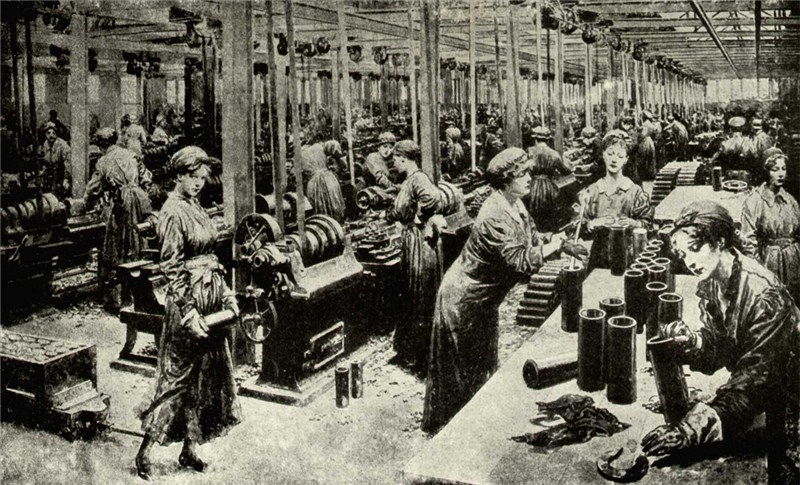
The German Munition Factory

WWI served as a catalyst for women writers to voice their observations and opinions on the war. Kate Kestien, author of When Our Men Lay in the Trenches, 1935, wrote about the hardships that women had to endure while the men were battling it out in the trenches.

In the excerpt from A Night in a German Munition Factory, Kestien describes the dangerous working conditions that the factory workers had to endure. She sets the scene in this piece by explaining how women had to work during the night shift, in order to be able to tend to their families during the day. They worked long strenuous hours in an unsafe environment, breathing in ether throughout their shift.

"It was at night that weariness crept into the limbs, especially around midnight, before the big break, when the air in the room had become dense and sticky.

The effects of ether gave some a "paralysing weariness" that interfered with their vision. It was these sleep deprived women, loopy from the ether, that had to operate razor sharp equipment that needed to be maneuvered precisely. Kestien writes of the fast pass that they were forced to work at. The author told of an incident in which a woman's left hand got severed while operating a cutting machine. This women couldn't afford not to work because her husband, lying in the hospital, was recovering from his own wounds he received in battle. Having four children at home she did not want to leave her post in the factory, until she realized the survevaty of her wound. After receiving medical care this women appeared relieved that it was her left hand so she could still function with her dominate hand.

Because of this injury, the armed guards were not pleased that the machines had to be shut down, they ordered the women to resume working as the injured women was being carried off to the hospital.

Monday, September 14, 2009

World War I Links

Chronology: Timelines
Overview: Secondary Sources
First Person: Primary Sources
Poetry & the Arts: