Wednesday, September 26, 2012
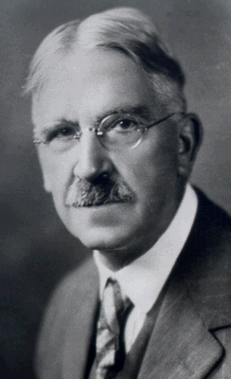
CONSCIENCE AND COMPULSION BY JOHN DEWEY
Monday, September 24, 2012
The Somme Still Flows
"The Somme Still Flows" by Edmund Blunden is an essay portraying the French and German war. Blunden is telling war from a soldier point of view. Throughout his essay, if felt as if there were truly no winners. Both parties of the war end up becoming failures because more times then not both sides involved will have a high number of causalities. The people who are able to make it out of the battlefield alive were traumatized at the visions that the war left etched in their minds.
Without people fighting over battle various battlegrounds there would be no such thing as war. The essay discusses how the Somme battle may be described as a big question mark.
“By the end of the day both sides had seen, in a sad scrawl of broken earth and murdered men, the answer to that question.”No matter how worst the bad became and it seemed evident that the war should not continue, however, both parties went on. For month’s attacks continued the casualty rate grew higher and higher. To my astonishment these men continued on their journey when nothing seemed to be promised to them except death.
Sunday, September 23, 2012
A Night in a German Munitions Factory
Kestian described how the smell of ether overtook her that first day in the factory. "You'll get used to it," promised an elderly worker. "Tomorrow you won't even notice it!" Only sometimes, Kestian explains, is she seized by a "paralysing weariness" that makes her "eyelids feel like lead" and gives her double vision.
Women that did the same job as Kestian used a cutting machine with razor sharp blades that would cut sticks of gun powder to be put in missiles. Other women then grabbed the sticks and bundled and packed them. These jobs required absolute concentration and accuracy at all times.
Many women, however, were forced to take night shifts so that they could tend to their children during the day and had little, if any, sleep. Exhaustion, coupled with dangerous equipment and the effects of the ether, made their work a ticking time bomb.
"I had been standing in my place at the table for about a week when it happened. A scream, as if from many mouths and yet just one single scream, rose through the room."
A woman's hand had been severed in half. She was a mother with four children at home--whose husband was already wounded in the war-- and was horrified at the prospect of having to go to the hospital herself. Although in shock, she knew she had to support her children.
"She felt for her injured hand and a smile crossed her deathly pale face. 'Thank God, it's only the left.' "
After the blood had been cleaned up, and they had a break, the women returned to their work.
"It's been one of those nights!" stated a supervisor. "But at least everyone keeps awake when things go crazy."
Thursday, December 22, 2011
NSC-68
Wednesday, December 21, 2011
"Our Days of Weakness are Over!"

Thursday, December 15, 2011
Our Days of Weakness Are Over - The U.S. Invasion of Grenada

After the United States called its loses in Vietnam the morale of the country was down. President Reagan was looking for an easy victory and in the Grenada located in the Caribbean was Reagan's perfect chance. There had been previous conflict between Grenada and the United States after Prime Minster Maurice Bishop who was a moderate Marxist-Leninist began to associate the country with Communist countries. Bishop had felt threatened by the United States and in fear of invasion became allied with the Soviet Union who supplied them with millions of dollars worth of military supplies for free. Grenada was seen as a threat to democracy but the United States did not have an valid reason to invade this reason. Vice President George. H. W. Bush along with a Special Situation group that was set up to handle the Grenada crisis began to articulate what form of military action was going to take place.
hop's rescue he was again captured. Jacqueline Craft, Bishop and six others were executed. This execution was the leading factor to the United States invasion in Grenada.The United States needed legal justification for the invasion. Secretary of State Charles Gillespie persuaded six Caribbean Prime Ministers from the Organization of East Caribbean States to sign on board with the United States invasion. These prime ministers signed for they wanted the United States "to take action for collective defense and preservation of peace and security against external aggression."
The U.S.S. ship Guam was told to change its root from it original destination in Lebanon. The United States will ill prepared for the invasion having little to no knowledge of who was in charge and how eq
uipped their military was. Despite the set back in lack of information the United States was well equipped militarily with troops of soldiers, planes, munitions and jeeps. "The mission, code-named Operation Urgent Fury, was to 'protect and evacuate U.S. and designated foreign nationals from Grenada, neutralize Grenadian forces, stabilize the internal situation, and...assist in the restoration of a democratic government on Grenada."Operation Urgent Fury was successful not only in Grenada but in restore the morale back on the home front. The reasoning behind this invasion is similar to other invasions that have taken place in the Caribbean such as Cuba, the Philippines, Guatemala and the Dominican Republic.
The Soviet Union moved with fear in response to the anti-communist formation NATO . The soviet Union concluded the Warsaw Pact with its satellites in May 1955. It included all communist states in Europe - Soviet Russia, Albania, Bulgaria, Hungary, Poland, Romania, Czechoslovakia and East Germany. The Pact spoke of peaceful intentions and defense. It allowed its members to participate in any other coalition or alliance but it assured members of immediate assistance, including the use of armed force, in the event of armed aggression from other countries. To provide for military assistance, a Russian Supreme Commander was appointed to lead the combined armed forces of its members. A committee was established to foster political understanding of its members.
In the Late 1980's the anti-soviet and anti communist movements through eastern Europe began to crack to the war saw pact. Members from the pact started to leave because they wanted to get away from communism.
The Soviet Union gave up their control of the war saw pact. A few months later the committee met one last time and they talked about what they accomplished. After that meeting the Warsaw pact was ended.
On March 31st, 1991 the Warsaw pact ended.
Wednesday, December 14, 2011
Address to the Nation on the Iran Arms and Contra Aid Controversy
On March 4th, 1987 President Ronald Reagan made a speech to the American public about the controversy with Iran and the release of the hostages held by the Hezbollah.
“But I’ve had to wait, as you have, for the complete story. That’s why I appointed Ambassador David Abshire as my Special Counsellor to help get out the thousands of documents to the various investigations. And I appointed a Special Review Board, the Tower board, which took on the chore of pulling the truth together for me and getting to the bottom of things.”Reagan discusses how he believes that America deserves the truth about the tragedy with the hostages and the controversy of selling weapons to Iran. Reagan was said to not have known about this controversy until it was shown to the public.
“First, let me say I take full responsibility for my own actions and for those of my administration. As angry as I may be about activities undertaken without my knowledge, I am still accountable for those activities.”While trying to regain trust from the American people with this statement he admits to lying to them about not trading arms for hostages. The entire controversy revolves around this concept along with the money that was sent to fund another war that we weren’t actually part of. He believed that selling the Iranians arms was a strategy in order to accomplish other goals but in fact it turned into an arms-for-hostage strategy, which is not what they had in mind.
“It’s clear from the Board’s report, however, that I let my personal concern for the hostages spill over into the geopolitical strategy of reaching out to Iran.”This was critical because of this scandal the United States needed to make sure they did everything possible to release these hostages but in a legitimate way. Reagan also promised the loved ones of these hostages that they would explore every possible avenue to rescue these hostages. On the other hand, suspiciously though the Board was unable to find any information about the money controversy.
“The Tower board wasn’t able to find out what happened to this money, so the facts here will be left to the continuing investigations of the court appointed Independent Counsel and the two congressional investigating committees.”Though he is willing to again take responsibility for these actions in which occurred it is strange to see that they were unable to find any information about the money. It is possible that Reagan did know what was happening and told the officials in his administration to destroy the evidence, but we will never know. Unfortunately American hostages were killed though many were released it is a great lose for the American people that we were unable to save our hostages from harm. The last American hostage was released on December 4th 1991; while the sad return of the last two deceased American hostages were returned late in December of 1991.

Tuesday, December 13, 2011
Edward R. Murrow vs. McCarthyism

McCarthy's rhetoric was not just about homefront protection against Communism. He was a member of the Republican party and many of his attacks happened to be people that fell into the left-wing. Many believe that his attacks against the Democratic party was influential in the election of Eisenhower. He was tough on what he called "liberal media" also. He wanted to make it seem that the left-wing was attacking him instead of the other way around.
On March 9th, 1954, respected journalist Edward R. Murrow took to his CBS show See It Now and refuted many of McCarthy's claims. Murrow basically
exposed the Senator's lies and did it in a way that used McCarthy's own words against him. He began the report by revealing two contradicting quotes made by the Senator in regards to his beliefs on starting trouble between the two political parties. In one quote he believes it would be detrimental to our society to eliminate the two-party system and in another quote he believes that it is inevitable and that the democratic party is guitly of treason. These two conflicting views allow Murrow to illustrate McCarthy as a flip-flopper who does not hesitate to divulge misinformation.
The Report than continues on to reveal comments McCarthy had made about Eisenhower who just so happened to be the candidate he was backing. McCarthy had critisized Eisenhower for expressing hope that Communism would become a thing of the past and not at the forefront of our political concerns. McCarthy clearly believed Communism was the largest threat to our society and he made many strides to ensure the issue would not just fade away. Murrow then moves on to reveal a statement McCarthy made in regards to a respected member of our army General Zwicker. Although this type of behavior was not uncommon of McCarthy it struck a chord with many American's that were uncomfortable with seeing the soldiers that protect our Country attacked. This was a huge reason for McCarthy's downfall.
An important piece of McCarthy's claims is that he was not the attacker and the liberal media was performing a smear campaign on him. In an effort to be forthcoming with that information Murrow lists certain headlines from newspapers around the United States on the subject of McCarthy's attack on the American army. Murrow than moves the subject along to McCarthy's campaign against Aldai Stevenson. Stevenson was the Democratic candidate up against
Eisenhower the both times he was elected. The report reveals a statement made by McCarthy accusing Stevenson of connection to a communist hide-out in a barn in Massachusetts. McCarthy begins his statement by saying "Strangely, Alger -- I mean, Adlai." This reference is too Alger Hiss, a government official who was convicted of being a spy for the Soviet Union. This already sets the tone for where McCarthy is going with his statement. Once the statement is finished Murrow brings out a piece of information that cuts completely at McCarthy's argument. His claim that Stevenson is named on a piece of paper in this Soviet hide-out is irrelevant because he does not expose that there are also three others from the state department that just so happened to be Republican were named in the capacity.
Lastly, Murrow reveals a hearing the McCarthy headed against a man named Reed Harris. Harris was a writer and United States government official. He was accused by McCarthy because of a statement he made in a book he wrote in 1932. After hearing the testimony of Harris and the accusations of McCarthy it becomes clear that McCarthy is really just fighting views that oppose his own rather than fighting for American safety. At the close of the report you know where Murrow stands on the subject and you are made aware of many of Senator McCarty's blunders. McCarthy's response to Murrows clear message was to disregard it as "liberal-media" and then go at Murrow personally and accuse him of ties to the Communist Party. Shortly after that McCarthy was completely exposed for what he was. His continued attacks on members of the American army crossed the line and McCarthyism came to an end.
Information From--
http://www.lib.berkeley.edu/MRC/murrowmccarthy.html
http://www.spartacus.schoolnet.co.uk/USAmurrow.htm