Tuesday, October 2, 2012

Journey to the End of the Night

Louis-Ferdinand Celine


Louis-Ferdinand Celine was a French novelist,pamphleteer, and physician who lived from May 1894 - July 1961. He wrote numerous works of literature that are still read today. Journey to the End of the Night was his first novel written in 1932. This novel was a semi-autobiographical work.

From the excerpt I read, it is clear that he was shocked at what was going on during the years of World War I. It was also evident that the main character never experienced war. He considered himself a "virgin" to war. He didn't feel comfortable in the war zone and regretted not committing a crime because he felt that being in jail would've ensured his safety.He said, "You come out of jail alive, out of a war you don't!" In the excerpt, he was describing the fight between his country, France and the enemy Germany during WWI. He was confused as to why the two countries were even at war to begin with. This is probably a thought that many of the soldiers of France were thinking. He knew how to speak German and even attended school in their country. The reason of being at war with Germany was a question he did not know the answer too. This man was afraid and was questioning his manly-hood. He states, " Could I, I thought, be the last coward on earth." The reason he is saying this is because the environment around him was so hectic; It was complete madness around him with constant gunfire and explosions, it drove some people crazy.


"Those unknown soldiers missed us every time, but they spun a thousand deaths around us, so close they seemed to clothe us. I was afraid to move." (Celine p.8-9)

The new machine gun that the German forces used against their enemies.
- This quote seemed important to discuss because it describes how scared he was throughout his time in battle. Even though he didn't get killed, he witnessed a lot of deaths around him and it changed his psyche.


"And so he stood on the embankment, stiff as a board, swaying, the sweat running down his chin strap; his jaws were trembling so hard that little abortive cries kept coming out of him, like a puppy dreaming. You couldn't make out whether he wanted to speak to us or whether he was crying." (Celine p. 11)

- This was a significant quote in the reading because it describes the fear and emotions that a cavalryman felt after seeing his Sergeant be killed. I also like this quote because it shows how hard it must have been mentally for these men.

                                                                WWI video of Trench Warfare

Including the millions of people who died there also was a massive number of casualties that were forever affected from this devastation in history.

This is a video of people with"shell shock" which is a result of being in war. The content of this video are disturbing and sad.

Reference:
Louis-Ferdinand Celine. Journey to the End of the Night. Published 1932.

http://www.themodernnovel.com/french/celine/author.htm


Wednesday, September 26, 2012

Do you believe Americans should have join the World War I ?


John Dewey

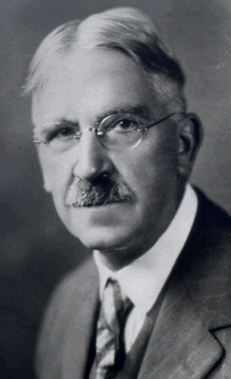
John Dewey was an American Psychologist, Philosopher, educator, Social critic and political activist. He wrote "Conscription of thought".

America was unsure about joining the war. However, John Dewey believed America should have join the war. According to John Dewey "Men pay more for flour and beef steak whether they like it or not, and at countless social points they have to ask themselves whether they will make a sacrifice willingly from sense, of union with their fellows, or sourly, peevishly, disgruntedly, in a sense of isolation."

John Dewey was asking the Civilian population will you join the union or shy away from the war.
John Dewey do not want United States of America to be isolated.


Civilian protesting against the war

"There is probably no one in the country who was not aware that many persons among us were pro German in their sympathies; that there were others who were opposed to all war and yet others were
opposed to all war and yet others with whom this war was unpopular, and others who centered their hostility upon, the policy of conscription. Alot of people were against the war because the aftermath of any war was horrible.

Why should United States join the War ?


Soldiers getting ready to go to war

According to John Dewey " we justify our attacks and suppressions on the rational ground that Social Cohesion is a necessity and that we are simply taking measures to secure Union."

United states of America entered the war because we want to be apart of a union.

John Dewey believed that if the President do not join the war we would missed one of the greatest contribution.

According to John Dewey if  " we don't join the war we shall missed the great experience of discovering the significance of American national life by seeing it reflected into the remaking of the life of the world.Without this experience we shall miss the contribution which the war has to make the creation of a United America.


CONSCIENCE AND COMPULSION BY JOHN DEWEY


Name: John Dewey
D.O.B/D.O.D: Oct. 20, 1859 – June 1, 1952
Profession: American Philosopher, Psychologist, Educational Reformer
Some Famous Works: Human Nature (1917), Conscience and Compulsion (1917),
Human Nature and Conduct (1922), A Common Faith (1934)

The piece that I analyzed was from the document called Conscience and Compulsion (1917).

“One of my most depressing experiences in connection with this matter was the number of young men who when war was actually declared merely clumsily rolled their conscience out from under the imperative of “Thou shalt not kill” till it settled under the imperative of “Obey the law,” although they still saw the situation exactly as they had seen it before”.

To begin, John Dewey did not want to enter the war. He opposed it. He thought it would disrupt the progressive movement. In addition, he thought the war would have a negative impact on American society and only the industrialists and bankers would benefit.

The excerpt that I chose above was very interesting to me. At first, he was describing the way he felt when all of these young men were sent to war. It was depressing. The reason why was because Dewey thought that America really did not have a sound reason to enter the war. As stated in the quote, the soldiers first went to war because they were defending the concept of “Thou shalt not kill”. They were fighting for the men that lost their lives during the sinking of Lusitania. However, after the war their reason changed. “Obey the law” was why they fought. In their prospective, the law allowed them to go to war.

I also noticed that both reasons were from the Bible. “Thou shalt not kill” is part of the 10 Commandments and “Obey the law” is from Romans 13:1-7. The Bible tells you to follow the 10 Commandments but also to follow the laws of the land. There are laws wherever you go therefore it was a justification to enter World War 1.

Monday, September 24, 2012

The Somme Still Flows


"The Somme Still Flows" by Edmund Blunden is an essay portraying the French and German war. Blunden is telling war from a soldier point of view. Throughout his essay, if felt as if there were truly no winners. Both parties of the war end up becoming failures because more times then not both sides involved will have a high number of causalities. The people who are able to make it out of the battlefield alive were traumatized at the visions that the war left etched in their minds.
Without people fighting over battle various battlegrounds there would be no such thing as war. The essay discusses how the Somme battle may be described as a big question mark. 
“By the end of the day both sides had seen, in a sad scrawl of broken earth and murdered men, the answer to that question.” 
No matter how worst the bad became and it seemed evident that the war should not continue, however, both parties went on. For month’s attacks continued the casualty rate grew higher and higher. To my astonishment these men continued on their journey when nothing seemed to be promised to them except death.

Sunday, September 23, 2012

A Night in a German Munitions Factory

The role of women in industry during World War I was pivotal, no matter which side of the battle they were on.  Kate Kestian's passage from her book, "When Our Men Lay in the Trenches" described the frightening, unsafe conditions that women faced while working in a munitions factory for the German side, while their husbands were fighting on the front lines. 

Kestian described how the smell of ether overtook her that first day in the factory.  "You'll get used to it," promised an elderly worker.  "Tomorrow you won't even notice it!"  Only sometimes, Kestian explains, is she seized by a "paralysing weariness" that makes her "eyelids feel like lead" and gives her double vision. 

Women that did the same job as Kestian used a cutting machine with razor sharp blades that would cut sticks of gun powder to be put in missiles.  Other women then grabbed the sticks and bundled and packed them.  These jobs required absolute concentration and accuracy at all times.

Many women, however, were forced to take night shifts so that they could tend to their children during the day and had little, if any, sleep.   Exhaustion, coupled with dangerous equipment and the effects of the ether, made their work a ticking time bomb.

"I had been standing in my place at the table for about a week when it happened.  A scream, as if from many mouths and yet just one single scream, rose through the room."

A woman's hand had been severed in half.   She was a mother with four children at home--whose husband was already wounded in the war-- and was horrified at the prospect  of having to go to the hospital herself.    Although in shock, she knew she had to support her children.

"She felt for her injured hand and a smile crossed her deathly pale face. 'Thank God, it's only the left.' "

After the blood had been cleaned up, and they had a break, the women returned to their work.

"It's been one of those nights!" stated a supervisor.  "But at least everyone keeps awake when things go crazy."


Thursday, December 22, 2011

NSC-68


NSC 68 is a document, written in 1950 to analyze the course of action available to the President of the United States in defense to the Soviet Union during the ongoing Cold War. NSC 68 focuses on the military, economic, political and psychological standpoints of the United States in relation to the Soviet Union.  NSC 68 was presented to President Harry S. Truman by his National Security Council and was primarily written by Paul H. Nitze.  Nitze proposed that the U.S. take a more drastic and aggressive form of foreign policy to safeguard the nation, as well as the free world from communist rule.  NSC 68 focused on the need for a massive military buildup, an increase in military funding for the armed forces, and authorization for the development of the hydrogen bomb.

In response to President Truman's request to the National Security Council, NSC 68 was to conduct "a re-examination of our objectives in peace and war and of the effect of these objectives on our strategic plans".  NSC 68 called for immediate action and contained a detailed outline portraying a proposal for extreme changes in the current U.S. foreign policy of containment. NSC 68 proposed the need for an aggressively larger, and more prepared military, including higher funding to back its expansion.  At the time of NSC 68 most agreed that diplomatic solutions were fully exhausted and military might was the only thing that would slow the Communist expansion. 

NSC 68 was an important Cold War document because it presented a world view of that conflict, which engaged U.S. society for nearly forty years. It portrayed a world divided by an epic struggle between two ideologies, in which the outcome could only be victory or defeat. It provided the justification for rearming the United States after World War II while prompting an arms race. Although actual war with the Soviet Union never occurred, NSC 68 helped put the United States on a war footing for generations, thereby contributing to the shaping of American society and culture during the second half of the twentieth century.  NSC-68 was an important part of an overall shift in American foreign policy to a full containment strategy that was established by following administrations. 

Wednesday, December 21, 2011

"Our Days of Weakness are Over!"


THE INVASION OF GRENADA
The invasion of Grenada, codenamed "Operation Urgent Fury", was the 1983 US-led invasion of the Caribbean Island (located 100 miles north of Venezula).
A bizarre series of events took place in mid October on the tiny Caribbean island. This was the first major operation conducted by the US Military since the Vietnam War.
President Ronald Reagan initiated the invasion, and created the National Security Decision Directive, which authorized military commanders to prepare options for possible action in Grenada.
The invasion was triggered by building tensions between the militaries, and the fact that President Reagan was informed of the "secret" construction of large airports and long runways, which to Americans was a threat of an attack.
There were several hundered American students who were attending a medical school in Grenada, so the main concern was their evacuation and safety.
The people had voted Reagan into presidency in 1980 because he promised to restore the "standing" of the
United States. Grenada gave him this chance..
Vice President George Bush called to report that the Special
Situation Group favored an operation that would not only
"secure American citizens, but restore democratic rule and end Cuban influence...that meant a full-scale invasion and overthrow of Grenada's government.
"If we've got to go there"..."We might as well do all that needs to be done"
- Ronald Reagan
The United States had no choice but to act strongly and decisively in order to defend its nation from any outside threats. The government of the United States had to save Grenada and the region from a "brutal gang of Leftist thugs".
There are two basic reasons that determined the President's decision to invade Grenada,
First, was his concertn for the welfare of American citizens living on Grenada.
Second, due to elements of grave concern to their safety and peace taking place. United States needed to assist in insuring and reinstating peace and stability in Grenada.
The Invasion aimed for and resulted in the restoration of a constituional government. Nearly 8,000 soldiers, airmen, and Marines participated in the invasion. Only 19 Americans were killed.
The invasion was justified and had support of Americans and the surrounding countries. University students were at risk and could have been taken hostage, the US had to take control of the situation at hand.
The problems that were faced during the invasion were due to lack of intelligence.
Americans faced difficulties navagating through unknown territory. An analysis by the United States Department of Defense showed a need for improved communications and coordination between branches of the United States forces and outsiders.
This video shows President Ronald Reagan discussing the invasion of Grenada.

Thursday, December 15, 2011

Our Days of Weakness Are Over - The U.S. Invasion of Grenada


After the United States called its loses in Vietnam the morale of the country was down. President Reagan was looking for an easy victory and in the Grenada located in the Caribbean was Reagan's perfect chance. There had been previous conflict between Grenada and the United States after Prime Minster Maurice Bishop who was a moderate Marxist-Leninist began to associate the country with Communist countries. Bishop had felt threatened by the United States and in fear of invasion became allied with the Soviet Union who supplied them with millions of dollars worth of military supplies for free. Grenada was seen as a threat to democracy but the United States did not have an valid reason to invade this reason. Vice President George. H. W. Bush along with a Special Situation group that was set up to handle the Grenada crisis began to articulate what form of military action was going to take place.

The perfect opportunity arose when Prime Minister Bishop had been overthrown by a supposed comrade Bernard Coard. Coard despite his lack of public support became the new Prime Minister of Grenada and arrested Bishop. Bishop was found by his supports tied to his bed along with the Minister of Education Jacqueline Craft and released. Shortly after Bishop's rescue he was again captured. Jacqueline Craft, Bishop and six others were executed. This execution was the leading factor to the United States invasion in Grenada.

The United States needed legal justification for the invasion. Secretary of State Charles Gillespie persuaded six Caribbean Prime Ministers from the Organization of East Caribbean States to sign on board with the United States invasion. These prime ministers signed for they wanted the United States "to take action for collective defense and preservation of peace and security against external aggression."

The U.S.S. ship Guam was told to change its root from it original destination in Lebanon. The United States will ill prepared for the invasion having little to no knowledge of who was in charge and how equipped their military was. Despite the set back in lack of information the United States was well equipped militarily with troops of soldiers, planes, munitions and jeeps. "The mission, code-named Operation Urgent Fury, was to 'protect and evacuate U.S. and designated foreign nationals from Grenada, neutralize Grenadian forces, stabilize the internal situation, and...assist in the restoration of a democratic government on Grenada."

Operation Urgent Fury was successful not only in Grenada but in restore the morale back on the home front. The reasoning behind this invasion is similar to other invasions that have taken place in the Caribbean such as Cuba, the Philippines, Guatemala and the Dominican Republic.


The End of the Warsaw Pact


The Soviet Union moved with fear in response to the anti-communist formation NATO . The soviet Union concluded the Warsaw Pact with its satellites in May 1955. It included all communist states in Europe - Soviet Russia, Albania, Bulgaria, Hungary, Poland, Romania, Czechoslovakia and East Germany. The Pact spoke of peaceful intentions and defense. It allowed its members to participate in any other coalition or alliance but it assured members of immediate assistance, including the use of armed force, in the event of armed aggression from other countries. To provide for military assistance, a Russian Supreme Commander was appointed to lead the combined armed forces of its members. A committee was established to foster political understanding of its members.

In the Late 1980's the anti-soviet and anti communist movements through eastern Europe began to crack to the war saw pact. Members from the pact started to leave because they wanted to get away from communism.

The Soviet Union gave up their control of the war saw pact. A few months later the committee met one last time and they talked about what they accomplished. After that meeting the Warsaw pact was ended.

On March 31st, 1991 the Warsaw pact ended.


Wednesday, December 14, 2011

Address to the Nation on the Iran Arms and Contra Aid Controversy

Between 1980 and 1988 Iran and Iraq were involved in a war with each other also known as the Persian Gulf War. During the war Iran found it difficult to find nations in which to supply them with weapons in which they needed to win the war. Between 1982 and 1992 the Islamic fundamentalist group, later identified as the Hezbollah, kidnapped over 100 hostages from multiple nations and killed 230 Americans in the Embassy Bombings in Beirut. This was known as the Lebanon Hostage Crisis. The reason for the hostages may very well have been to protect themselves from retaliation of the United States or other countries. The Israeli government supported the Iraqi’s during the war and was willing to supply them with weapons as long as they could be reimbursed from the United States. The controversy began when the Reagan administration officials began to secretly sell weapons to Iran. The plan was that Israel would ship weapons to Iran and then the United States would reimburse Israel and receive their payment. When the Iranians were receiving the weapons they promised to attempt to do everything in their power to get the American hostages released from a terrorist group that was tied to Iran. This changed to an arms-for-hostage scheme in which the government sold weapons to Iran for the release of American hostages. The hostages were sparatically released when the Iranians received the weapons in which they wanted. When America received their payments proceeds of the money went to funding Anti-Sandinista and anti-Communist rebels in Nicaragua. This part of the plan was created by Oliver North who was a member of the National Security Council. Funding the Contras in Nicaragua was illegal as part of the Boland Amendment.

On March 4th, 1987 President Ronald Reagan made a speech to the American public about the controversy with Iran and the release of the hostages held by the Hezbollah.
“But I’ve had to wait, as you have, for the complete story. That’s why I appointed Ambassador David Abshire as my Special Counsellor to help get out the thousands of documents to the various investigations. And I appointed a Special Review Board, the Tower board, which took on the chore of pulling the truth together for me and getting to the bottom of things.”
Reagan discusses how he believes that America deserves the truth about the tragedy with the hostages and the controversy of selling weapons to Iran. Reagan was said to not have known a
bout this controversy until it was shown to the public.
“First, let me say I take full responsibility for my own actions and for those of my administration. As angry as I may be about activities undertaken without my knowledge, I am still accountable for those activities.”
While trying to regain trust from the American people with this statement he admits to lying to them about not trading arms for hostages. The entire controversy revolves around this concept along with the money that was sent to fund another war that we weren’t actually part of. He believed that selling the Iranians arms was a strategy in order to accomplish other goals but in fact it turned into an arms-for-hostage strategy, which is not what they had in mind.
“It’s clear from the Board’s report, however, that I let my personal concern for the hostages spill over into the geopolitical strategy of reaching out to Iran.”
This was critical because of this scandal the United States needed to make sure they did everything possible to release these hostages but in a legitimate way. Reagan also promised the loved ones of these hostages that they would explore every possible avenue to rescue these hostages. On the other hand, suspiciously though the Board was unable to find any information about the money controversy.
“The Tower board wasn’t able to find out what happened to this money, so the facts here will be left to the continuing investigations of the court appointed Independent Counsel and the two congressional investigating committees.”
Though he is willing to again take responsibility for these actions in which occurred it is strange to see that they were unable to find any information about the money. It is possible that Reagan did know what was happening and told the officials in his administration to destroy the evidence, but we will never know. Unfortunately American hostages were killed though many were released it is a great lose for the American people that we were unable to save our hostages from harm. The last American hostage was released on December 4th 1991; while the sad return of the last two deceased American hostages were returned late in December of 1991.