Tuesday, September 22, 2009

Conscription of Thought


John Dewey (1859-1952) was an American born philosopher, as well as, a psychologist and education reformer. His school of thought fell under the title of pragmatism which is a naturalistic approach to learning where knowledge is acquired from the environment in which the human lives. Dewey’s work was extensive and covered areas from philosophical concerns of the day to the social and political issues of the time.


After the beginning of World War One, a “substantial part of his published output consisted of commentary on current domestic and international politics, and public statements on behalf of many causes.” He was a believer in progressive social change and a supporter of American intervention in the war. Dewey saw the war as a necessary evil. He felt it was something that had to be dealt with and why not use it as an outlet for social reform if the opportunity arose. To quote him directly, “the future of our civilization depends upon the widening spread and deepening hold of the scientific cast of mind.”


“Conscription of Thought” can best be defined as a mandatory uptake of thought not just feeling and acting. The article discusses the argument that social cohesion “is best attained along with intellectual and emotional unity.” However, the effectiveness of the American intervention is “likely to be hampered by lack of those ideas.” Ultimately for Americans to be successful in their intervention, “participation should consist not in money nor in men, but in the final determination of peace policies which is made possible by the contribution of men and money.”

369th Infantry "Harlem Hellfighters"


"Harlem Hellfighters" the 369Th Infantry Regiment an all black military unit that fought with bravery and valor during World War I. The unit was first established in 1913 as the 15Th New York (colored) Infantry Regiment a unit of the National Guard. They were among the first 100,00 troops of the American expeditionary Force to arrive in France in 1918. This regiment was an important piece of the 4Th French Army and fought until Armistice during the Meuse - Argonne Offensive. They were the first American Unit to be awarded the French military highest honor the Croix de Guerre. The "Hellfighters" served 6 months at the front lines and suffered more then 1400 casualties. Germans gave the 369Th the nickname "Hellfighter" because in 190 days of duty at the front they never had any men captured or ground taken. Sergeant Henry Lincoln Johnson is one of the most famous soldiers of the regiment. Johnson while on sentry duty engaged a raiding group of 20 Germans in an intense skirmish that included hand to hand combat that included the use of Sergeant Lincolns bolo knife. He was severely wounded but also managed to rescue a fellow soldier who was being captured by the Germans. His actions were not recognised until he received posthumously the Purple Heart in 1996 and the military second highest honor in 2003 the Distinguished Service Cross.

Sunday, September 20, 2009

John Dewey "Conscience and Compulsion"


When World War I began in 1914, there were many mixed emotions about the war.

John Dewey, an American philosopher and educational theorist, supported the war. In the article "Conscience and Compulsion", Dewey explains that many people, mostly the youth of America, have felt moral strain since war was declared by the United States.

Dewey thought that the reason for the conflict of emotion in America's youth stemmed from religious sources, schools, and parent's values. America's youth were being taught morals (ie-not to kill) that could not be reconciled with President Wilson's decision to go to war.

While many people felt that peace was unattainable through conflict, Dewey states that in order to have peace for all, armed conflict is sometimes necessary. Dewey felt that the means should not justify the end, but the end should justify the means. In other words, the attaining of peace should not be as important as peace itself.


Saturday, September 19, 2009

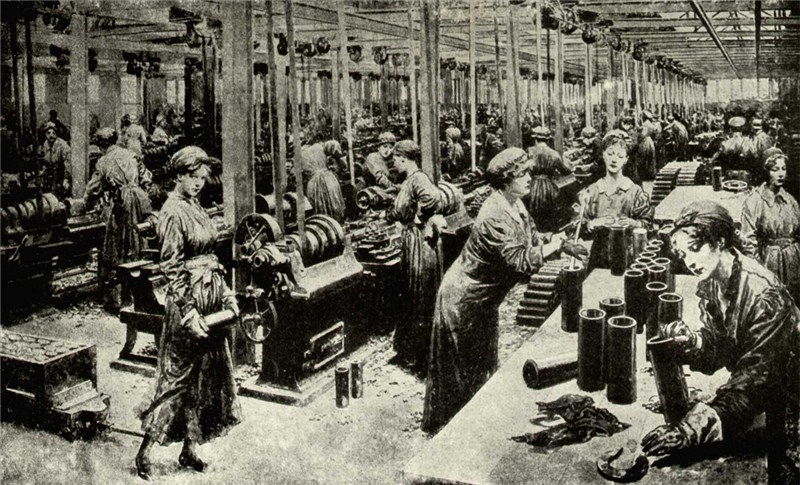
The German Munition Factory

WWI served as a catalyst for women writers to voice their observations and opinions on the war. Kate Kestien, author of When Our Men Lay in the Trenches, 1935, wrote about the hardships that women had to endure while the men were battling it out in the trenches.

In the excerpt from A Night in a German Munition Factory, Kestien describes the dangerous working conditions that the factory workers had to endure. She sets the scene in this piece by explaining how women had to work during the night shift, in order to be able to tend to their families during the day. They worked long strenuous hours in an unsafe environment, breathing in ether throughout their shift.

"It was at night that weariness crept into the limbs, especially around midnight, before the big break, when the air in the room had become dense and sticky.

The effects of ether gave some a "paralysing weariness" that interfered with their vision. It was these sleep deprived women, loopy from the ether, that had to operate razor sharp equipment that needed to be maneuvered precisely. Kestien writes of the fast pass that they were forced to work at. The author told of an incident in which a woman's left hand got severed while operating a cutting machine. This women couldn't afford not to work because her husband, lying in the hospital, was recovering from his own wounds he received in battle. Having four children at home she did not want to leave her post in the factory, until she realized the survevaty of her wound. After receiving medical care this women appeared relieved that it was her left hand so she could still function with her dominate hand.

Because of this injury, the armed guards were not pleased that the machines had to be shut down, they ordered the women to resume working as the injured women was being carried off to the hospital.

Monday, September 14, 2009

World War I Links

Chronology: Timelines
Overview: Secondary Sources
First Person: Primary Sources
Poetry & the Arts:


Friday, September 11, 2009

Who said, "The sun never sets on the British Empire?"

The sun never sets on the British Empire

(idea) by dabcanboulet Mon Apr 05 2004 at 6:00:21

The sentiment expressed by these words first appeared in Christopher North's 1829 work Noctes Ambrosianae. The actual words used by Christopher North were 'His Majesty's dominions, on which the sun never sets' (as these words were written in 1829, the "Majesty" in question would have been King George IV).


--------------------------------------------------------------------------------

The meaning of the words is, of course, quite clear - that the British Empire spanned the entire globe with the result that the sun was always up in some part of the Empire. The "self-evident truth" of the sentiment in 1829 was soon expressed in the less formal "The sun never sets on the British Empire" form, a sentence and a sentiment which certainly became a foundational part of the British psyche during the coming reign of Queen Victoria.


--------------------------------------------------------------------------------

From a historical perspective, the words were true from roughly the foundation of the East India Company in 1600 through to the end of the Second World War.

The exact dates at either end of the range are certainly open to debate. For example, did the British Empire come to an end with the founding of the British Commonwealth of Nations in 1931 or with the departure of the British from India and the partition of India into India and Pakistan in 1947? In truth, the British Empire did not simply come into being one day and cease to exist on some other day so the exact dates are not particularily relevant. The fact remains that the British Empire did span the globe for a truly impressive period of roughly 350 years.

"Imperialism Hostile to Liberty"


Charles Schurz (March 2, 1829 - May 14, 1906) was a reformer and a military general. He is noted to being the first German born American elected to the US Senate. As far as his political affiliation is concerned, he was a true Republican and campaigned for Abraham Lincoln. After the election Schurz was appointed US Envoy to Spain.

Schurz can be noted for his anti-slavery views and due to his passion he became a member of the Union Army. After success in many important battles he moved up in the ranks to a General. A quote that he is noted for, "my country, right or wrong; if right, to be kept right; and if wrong, to be set right," displays his ideals for a better America.

At Schurz’s core he was a man of morals and was an anti-imperialist during the Spanish American War. In the essay “Imperialism Hostile to Liberty,” Schurz declares why imperialism is wrong and unjust. “We insist that the subjugation of any people is ‘criminal aggression’ and open disloyalty to the distinctive principles of our government.” Here he is trying to explain that by conquering other peoples and lands we are openly going against principles of what America was founded on. He also said, “we earnestly condemn the policy of the present national administration in the Philippines.” This statement is self-explanatory in that he was against the U.S. government trying to overtake the Philippine Islands. Ultimately, “those who deny freedom to others deserve it not for themselves.”

Thursday, September 10, 2009

Spanish American War Poetry Resources


Several Spanish American War poetry compilations are available on Google Books.  They are searchable:

 War-time echoes; patriotic poems, heroic and pathetic, humorous and dialectic, of the Spanish-American war.  [Brownlee, James Henry, comp., Akron, O., New York: Werner, 1898.]

 War poems, 1898;  [comp. by the California club, with illustrations by W. H. Bull and Gordon Ross. San Francisco: The Murdock press, 1898.]

Spanish-American war songs. A complete collection of newspaper verse during the recent war with Spain.  [Witherbee, Sidney A., comp. and ed, Detroit: Sidney A. Witherbee, 1898.]

Reminiscences and thrilling stories of the war by returned heroes : containing vivid accounts of personal experiences by officers and men  [Young, James Rankin, and J. Hampton Moore. Philadelphia: Shepp, 1899.

Wednesday, September 9, 2009

Big Government...

Iam an African American and I love President Obama just as much as any other liberal...but Mr. Clinton told us that big government was obsolete. I think Obama's campaign of "change" in these harsh economic times might be the rise of the "NEW SOCIAL ORDER". Love it or leave it

Tuesday, September 8, 2009

Flags of our Fathers

I recently finished reading Flags of our Fathers, by James Bradley (the son of one of the surviving men that raised the flag). It is about the six men that raised the flag on Iwo Jima during World War II. Even though there is proof that these men raised the flag, there was alot of controversy over the actual picture.
Out of the six men that raised the flag only three survived, Ira Hayes, John "Doc" Bradley, and Rene Gagnon. When the picture made its way back into the United States shortly after it was taken, these three men were immediately sent home from combat. They were greeted in Washington by the President and his cabinet. They were called "heroes" and thanked for their courage in such a risky battle. They were turned into celebrities and asked to tour around the country and share their story about that fateful day. However, this was not what the men wanted at all and they actually had a different story to tell people.
The men did not in any way feel like heroes. John Bradley constantly stated "the real heroes are the ones that never came home from Iwo." Bradley, a corpsman never took any credit for the actions he took and the many lives he helped and tried to save on Iwo Jima. Later on in his life he never once spoke of the things he did and saw back there. Even his family never knew that he received the medal of honor until after he died.
Ira Hayes was never the same after he came back from Iwo. He turned to drinking and found himself in jail a few times for it. After years of struggling with alcoholism he passed away after he was found laying outside in the snow...intoxicated.
Rene Gagnon was the only man that did accept some credit for the events that occurred. He accepted the tour around the country and openly shared his story with others. he was proud to be part of that photo, but he too never spoke much of all the good friends that he left behind.
The intriguing part about the photograph was that it was not the first flag that was raised on Iwo Jima, in fact it was a replacement flag. The men did not see raising the flag as a sign of patriotism like the people back home did. Many of the men referred to the photo as "I saw some guys raising a pole and jumped in to help" and "If i had it any other way, I wouldn't have been in the picture, I don't feel like a hero and never will be one" and "It was only a picture." None of the men in the photograph saw it as being anything more than a picture. They had no intentions of becoming famous and they feel that the real heroes are the other men in the photograph that did not live to share their story.
This was one of the best history books I have ever read. Bradly does an exceptional job at really describing the lives of the men that were over analyzed and portrayed in different ways throughout the United States. He wrote about their childhood, their experiences in the Marines, and their lives after the war. Bradley deserves a lot of credit for the amount of effort he gave to really tell the story the way he knew his father would have wanted it.

Kate Ludwig