Thursday, October 6, 2011

Randolph Bourne: The War and The Intellectuals

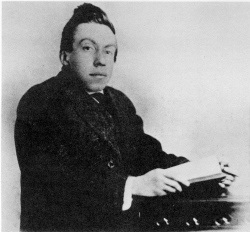
Randolph Bourne was an American journalist. His article The War and The Intellectuals was published in a literary journal called The Seven Arts in June of 1917, a few months after the United States entered the war. In the article, Bourne wrote critically of the intellectual class and their backing of the war.  
 "If our intellectuals were going to lead the administration, they might conceivably have tried to find some way of securing peace by making neutrality effective. They might have turned their intellectual energy not to the problem of jockeying the nation into war, but to the problem of using our vast neutral power to attain democratic ends for the rest of the world and ourselves without the use of the malevolent technique of war. They might have failed. The point is that they scarcely tried."
Bourne felt that the intellectuals of the age should have tried harder to find a solution for the problems in Europe that wouldn't result in war. He thought that American neutrality should have been used to resolve the issues at the root of the war.
 "We go to war to save the world from subjugation! But the German intellectuals went to war to save their culture from barbarization! And the French went to war to save their beautiful France! And the English to save international honor! And Russia, most altruistic and self-sacrificing of all, to save a small State from destruction! Whence is our miraculous intuition of our moral spotlessness? Whence our confidence that history will not unravel huge economic and imperialist forces upon which our rationalizations float like bubbles?"
Bourne disagreed with the "reasons" that America went to war. He saw those reasons as rationalizations and excuses made by intellectuals who were not strong enough to stand up against the tide and push for the unpopular anti-war agenda. He did not think that those excuses would hold up under deeper scrutiny.
"The case of the intellectuals seems, therefore, only very speciously rational. They could have used their energy to force a just peace or at least to devise other means than war for carrying through American policy. They could have used their intellectual energy to ensure that our participation in the war meant the international order which they wish. Intellect was not so used. It was used to lead an apathetic nation into an irresponsible war, without guarantees from those belligerents whose cause we were saving."
Again, Bourne thought that the United States should not have entered the war. He thought that we should have used our distance and neutrality to bring about a peaceful resolution to the war. He did not think that the intellectuals effectively used their intelligence to diplomatically resolve the issues behind the war. 
"There seems no choice for the intellectual but to join the mass of acceptance. But again the terrible dilemma arises,  – either support what is going on, in which case you count for nothing because you are swallowed in the mass and great incalculable forces bear you on; or remain aloof, passively resistant, in which case you count for nothing because you are outside the machinery of reality."
 Bourne saw war not as a foregone conclusion, but something to be fought against relentlessly. He understood why so many intellectuals went along with the war. He saw that they thought fighting against it was hopeless and that being for the war would at least keep them free and from being persecuted. But still, he argued against it. He argued that war was not the solution, but the bigger problem. He was disappointed in American intellectuals for going along with the war and he fervently tried to dissuade them from that path.


Conscience and Compulsion John Dewey 1914


Dewey believed that the mixed feelings regarding the war were all due to the moral upbringing of the youth during the time. He believed the war to be necessary and inevitable, but also knew that the beliefs the youth were raised with lead to the confusion of the time.

Dewey goes on to say that it isn’t strange that thousands of the youth were perplexed and morally confused with the idea of war. The youth grew up surrounded by Pro-Peace ideals. The clergymen didn’t even discuss politics as it was so closely related with “the struggle for Economic power”. They were raised by parents that had strict ideals on war and taught those theories to the children, and as he states it was a “penalty” that was due to the upbringing and unusual moral emphasis that focused on the emotions and morals rather than the Specific purposes. War was a crime because of murder, and “The belief that by NOT doing something, by keeping out of war our responsibilities would be met.”

A quote that best explains and summarizes his overall idea is as follows….

“…The denial of the efficiency of force, no matter how controlled, to modify disposition; in short the inveterate habit of separating ends from means and then identifying morals with ends thus emasculated…are the source of much of the perplexity of conscience from the idealistic youth has suffered.”


Dewey states lists some specific situations that lead to this moral hatred of war...

The bad aftertaste from the Spanish American War,

The Contentment generated by successful industrialism,

The General Humanitarianism,

The gradual substitution of calculating rationalism for the older romantic patriotism”


As per Dewey, “ all of these things and many more fell in with that general spirit of Good Will which is essential America, to create a sense of war as the Supreme Stupidity” . The youth of the time grew up with the ideals of war being a moral tragedy and looked at war with disgust. It seemed to be the murder “and murder of a peculiarly stupid sort”. This being said, of course the youth was confused on whether to join the war and be loyal to their country or if it was wrong to join the war, and go against their morals. As Dewey puts it “How could wrong so suddenly become right?” President Wilson was Illustrating war as something that was necessary in order to keep the peace. He made the war to be almost, Morally necessary. While on the other hand the youth were now being told to go against everything they were raised to believe was right. The youth were now being told that in order to have peace they need to go to war, and this idea was the most perplexing to them.
Tuesday, October 4, 2011


"The African Roots of War"


BY: W.E Burghardt DuBois


In the article, 'The African Roots of War' W.E. Burghardt DuBois explains the role that Africa played in causing World War. Many people saw Africa as this place so removed from World War but the Scramble for Africa was exactly what lead to war.

"Nearly every human empire that has arisen in the world, material and spiritual, has found some of its greatest crises on this continent of Africa,..."

This quote talks about how Africa has contributed to every place in the world in one way or another. DuBois point out how many scientific findings and even the religion of Christianity began in Africa. The nature resources of Africa had so much potential for expanding wealth that other nations rushed there in hopes of becoming rich.

"Yet in a very real sense Africa is a prime cause of this terrible overturning of civilization which we have lived to see and these words seek to show how in the Dark Continent are hidden the roots, not simply of war to-day but of the menace of war to-morrow"


The scramble for Africa was full of murder, rape, lies and theft. People knew that Continent was being robbed blind but those who weren't participating decided to look the other way. America and Britain went into Africa and took billions of African people which left them helpless to victimization by other nations.

Once in Africa the different nation looked to justify there presence by calling natives child-like and barbaric they said they stayed only to help civilize the people. Who were they to walk away from a people in need they said it was 'The White Man's Burden' to help out these people who couldn't help themselves. They said they were there as missionaries to give these people religion and stop them from being lazy by giving them meaning full work to do.

The attitude of superiority and divine right over other as well as the need to exploit other is what leads to the development of the color line.The citizens of France, America and Britain were no longer excepting the low wages and exploitation handed to them by the wealthy class. Europe had experience a revolution called The Enlightenment and European citizens were no longer excepting the inferior treatment. Unfourtanately thej obs that these nations had Dark Continents (i.e.:Africa, Asia, West Indies and Central America) doing were jobs that the took away from their working class.

"resultant jealousies and bitter hatreds continually fester along the color line. We must fight the Chinese, the laborer argues....We must keep the Negroes in their places, or Negroes will take our jobs."

The feelings and thoughts expressed in this quote is what would eventually lead to war and DuBois foresaw it. He warned that if peace was to be kept the reason for war would have to be eliminated. In order to avoid war the exploiting nation would have to extend the democratic attitudes to the Dark Continents not just their native lands.

When presented with the idea of Universal democracy it was said to be impossible they felt like if they left Africa, Africans would be unable to take care of themselves. I ask what were Africans doing before Eurpean influence? Were they not businessmen, farmers, parents and providers..

Well DuBois was right eventually the dishonesty, jealousy and the need for more power, laborers and resources would lead to the Exploiting nations going to war with each other.


John Dewey - "Conscription of Thought"

Who was John Dewey?
John Dewy (1859 -1952) was a well known American psychologist, philosopher and educator. His philosophies, ideas and teachings have had a great impact on education today. Not only did Dewey make contributions in the fields mentioned but he was also a major inspiration for several movements that shaped the twentieth century. He was a social critic and a political activist who wanted a liberal and progressive democracy.

What is John Dewey's "Conscription of Thought"?
In 1917, John Dewey wrote the article "Conscription of Thought". The article was mainly about the United States and their involvement in World War I. The War began in 1914 when the Archduke Franz Ferdinand was assassinated by the Serbs.


The United State had decided to stay neutral and not join the war. One of the events that started changing the mentality of neutrality was the Sinking of the Lusitania which killed 128 Americans and the Zimmerman Telegram. There seemed to be a split in the country. Some which were opposed to war and others that supported our entry into WWI. Dewey mentions in his article that

"There is probably no one in the country who was not aware that many persons among us were pro-German, in their sympathies; that there were others who were opposed to all war, and yet others who whom this war was unpopular, and others who centered their hostility upon the policy of conscription"

In his article he begins to talk about why people should not oppose our involvement in the war. He supported the United States joining not because he wanted to help the Allies win the war but because he felt that

"We shall have missed the greatest contribution which the war has to make to our future national integrity"

He believed if the United remained neutral,
"We shall have taken a step forward in overcoming a physical and territorial isolation from the world, but shall remain as provincially separate as before in thought and interest."

According to him, we managed to keep our self from the war, we managed not to get in debt and keep our men safe but in the end we also managed to make our country look weak. Which means that the "Big Powers" of the world who viewed us at a lower level before the war, will continue to view us as a weak country because we did not help in the effort to help them win the war.


John Dewey knew that World War I would bring about a great change not only in Europe but to the world. He knew that this war would be historic and the only ones missing from this historic moment would be the United States if they decided not to join the war.

It would not be enough for the United States to remain neutral and try to come to a peace agreement with the rest of the world that was fighting Dewey believed that ultimate American participation
"...should consist not in money nor in men, but in the final determination of peace policies which is made possible by the contribution of men and money"


All in all, John Dewey thought that if the United States joined WWI, we would not be helping the war by helping the Allies win but we would be also doing ourselves a favor by being a part of history. Joining the War would be the United States break through performance which will makes us a bigger and better country. We will gain acknowledgement and support from other countries but also will unite our county and most importantly will show the rest of the World that the United States is a force not to be reckon with.


"Above all we shall have missed the great experience of discovering the significance of American national life by seeing it reflected into a remaking of the life of the world. And without this experience we shall miss the contribution which the war has to make to the creation of a United America"


References:
"Conscription of Thought" - First Published in New Republic 12 (1917): 128 -30

John Dewey - Johnson, James Allen. Foundations of American education: perspectives on education in a changing world. 15th ed. New York: Merrill ;, 2010. Print.


Tuesday, September 27, 2011

The Conquest of Haiti


In the article, The conquest of Haiti, Herbert J. Seligman has a few talking points in regards to the United States role in occupying Haiti. The article talks about the struggles, Resistance, massacres and military presence/ role that occurred and positive aspects of occupying Haiti. I have selected a few quotes that I would like to elaborate on.


"The history of the American invasion of Haiti is only additional evidence that
the United States is among those Powers in whose international dealings
democracy and freedom are mere words, and human lives negligible in
the face of racial
snobbery, political chicane, and money."


The Americans wanted the invasion of Haiti to seem like it was for the benefit for the country or the people of the country when it was for the gains for the Americans. Throughout the whole process of the invasion, the Haitians were treated badly. Many Haitians died from military massacres.


"The invasion was one of defense against any Power which, taking control of Haiti, a weaker state, might use its territory as a base for naval action against the Panama Canal or the Unites States"

How I am understanding this quote from the article; the Americans wanted to protect itself from all that wanted to used the location of Haiti for their own personal defense against any potential attack against the United States or the Panama Canal.


"The American hold fortified by a convention empowering the United states to administer Haitian customs and finance for twenty years, or as much longer as the United states sees fit; and by revised Constitution of Haiti removing the Prohibition against alien ownership of land thus enabling Americans to purchase the most fertile areas in the country." This revision of the


Haitian Constitution was only for financial gain. The Americans took over land that would generate capital and make money off the Haitian land and leave the country in its demise. How is a country to thrive if most of its fertile lands are owned by Americans? How are the fruits of the Haitian labour brought back to the country? OK.... Yes there were a few accomplishments set forth like National Highways were built, all roads practically lead to the capital Port- Au- Prince, National Banks... But all were owned by Americans. Even the Sugar Mills and Lighting plants were owned by Americans. How are the Haitians supposed to prosper off of wealth that does not belong to them?


"One officer remarked to me that if he detest to draw a cartoon of the occupation of Haiti he wold represent a blank man held down by the white soldier, while another white man went through the black man's pocket."


This statement in itself speaks for itself but let me elaborate.... This statement alone represents the racial discrimination on blacks in the country; for instance the reference to the white soldier as apposed to saying a soldier... if this was not racially inspired then Soldier should have been a generalization as apposed to adding race with it. The quotes also talks about the white soldier holding the black man down.... this to me is a reference to the power the whites had over the blacks and the inequality. Lastly, the part of the quote that states " while another white man went through the black man's pocket" represents to me the lack of identity, individuality and loss of family in which the black man has had to deal with. To me this quote speaks truth to what black men and women have gone through throughout history. As people would always say 'This is a black man's struggle" never being able to hold anything down because some one is always taking from you and reminding you of who and what you are.... Inferior to the whites.


Wednesday, September 14, 2011

Yellow = Propaganda!!


Beware of what you read! If you were reading newspapers during 1883-1904, expect to have your opinions swayed by the editors and owners of these newspapers.


Above you see two, of many headlines, that the New York World published pre-, during, and post- the Spanish American War. Joseph Pulitzer, the same guy that the Pulitzer Prize is named after, owned the New York World during this time. To make this newspaper successful, he invested his time in fabricating and twisting facts to sell, sell, sell!


In "Blood, blood, blood!" and "I saw what was left," the graphic description that is portrayed, makes one think twice, today. Back in 1896, Society had been led to believe that what was printed, was truth, without questioning. Luckily, we are very fortunate to have many fact checkers in publishing world. The practices of Pulitzer and his rival, Hearst (pictured below,) would have whistle blowers going crazy.


http://en.wikipedia.org/wiki/Joseph_Pulitzer


http://en.wikipedia.org/wiki/Yellow_journalism

Imperialism-Its Dangers and Wrongs

 Samuel Gompers delivered his speech at the Peace Jubilee in Chicago, IL on October 18, 1898.  This quote is an excerpt of his speech:

"In our country we are perhaps too powerful to incur outside disaster; but
we shall certainly court worse evils at home if we try to benumb the
nation's sense of justice and love of right, and prevent it from striving
earnestly to correct all proved errors."


What is America's next move?
 The world will have to wait and see.
 Thequote by Gompers is referring to the power of the United States of America and its role in the annexation of the Philippines resulting in the migration of the Chinese, Negritos and the Malays to our country. It is a known fact that physical aggression towards a country reaps repercussions such as immigration of individuals with lower standards of living invading a country with social and financial opportunities such as America. Despite the fact that America has not had a skirmish on their own territory in more than thirty years, they are not above asserting their military authority in the annexation of other nations.  This poses an important question:  Is it fair for the United States to strong-arm the natives of the Philippines under our rule? If we do, it is certain that more lives will be taken and bloodshed is inevitable.  This, in turn, would bring us down to the level of the other world powers who practice Imperialism during the turn of the 20th Century. Although America is emerging as an assertive nation during the time of the Spanish-American War, such power through violent bullying is not typical of the peaceful beliefs of our government. Imperialism , on the other hand, demands respect by a dominant entity, with the use of violent force, while stripping the less dominant country of their dignity and pride.   Clearly at the end of the 19th Century, there is a definite question of Expansion versus Imperialism/Colonialism and it will be up to the United States to choose a course of action to rise to uphold our impending status.


Tuesday, September 13, 2011

Annexation of Santo Domingo

Ulysses S. Grant proposed a treaty to the US Senate in 1870, hoping to annex Santo Domingo. In the treaty Grant went on to explain why we should not only add the Dominican Republic as a territory, but why we should do so rather quickly.


As I was reading the treaty, it was clear to me that there were two reasons in particular that made Grant so favorable to adding the country. One was the country's location in the Carribean. The other was the economic value that Santo Domingo was worth. In the treaty Grant says "less than 120,000 souls, yet possessing one of the richest territories under the sun". Santo Domingo is one of the islands possessing the richest of soils, perfect for harvesting several crops.


In conclusion I think we all the know the results of this proposal as Santo Domingo is not a territory of the US like its neighboring island Puerto Rico, but it leaves us wondering what could have been?

The Better Part


Booker T Washington was an educator and a reformer. He was born on April 5, 1856 in Franklin County, VA and died November 14, 1915 in Tuskegee, Ala. Between the years 1895 and 1915 he was the most influential spokesman for African-Americans. One of his major platforms was that African-Americans needed to obtain economic security through education and learning industrial skills so that they could build up wealth and culture and that would help win the respect and acceptance of the white man. In this process though the African-Americans would have to give up the fight for civil rights and essentially accept segregation until they obtained that wealth and economic security that would gain the acceptance of the white man.
In the excerpt from "The Better Part" Speech from the Peace Jubilee in Chicago on October 16, 1898 by Booker T. Washington I found the following to be very poignant:


"But there remains on other victory for Americans to win...We have succeed in every conflict except in the effort to conquer ourselves in the blotting out of racial prejudice. We can celebrate the era of peace in no more effectual way than by a firm resolve in teh part of Northern men and Southern men, black men and white man, that the trenches we together dug aroung Santiago shall be the eternal burial-place of all that separates us in our business and civil relations. Let us be as generous in peace as we have been brave in battle. Until we thus conquer ourselves...we shall have a cancer gnawing at the heart of this Republic that one day shall prove as dangerous as an atttack from an army from without or within."


I think what Booker T. Washington is trying to say is why are we able to work and live together during a war to free others from oppression but in times of peace Americans can not achieve or work toward a society in their own country where all are equal and free. I think he is also saying that if Americans cannot find a way to reslove this issue it is not an attack from an army on the outside that we need to be concerned with but we should concern ourselves with how these tensions will destroy what America stands for: life, liberty and the pursuit of happiness.
Here is another quote that I found from Booker T. Washington that I think also points out the paradox of the American society at that time:

"In all things that are purely social we can be separate as the fingers, yet one as the hand in all things essential to mutual progress" (from a speech he deliver in Atlanta, Ga on September 18,1895)

Click here to see the program from the Peace Jubilee in Chicago.

The Economic Basis of Imperialism


Image found on this blog, among others.
In September 1898, Charles Arthur Conant wrote an article for the North American Review entitled “The Economic Basis of Imperialism”. Imperialism was a policy which, at the time, most Americans were against. But anti-imperialism was at odds with the treasured American ideals of free markets and Capitalism.
“The United States cannot afford to adhere to a policy of isolation while other nations are reaching out for the command of these new markets… New markets and new opportunities for investment must be found if surplus capital is to be profitably employed.”
American companies were producing more goods than the country could support and exports were subject to very high tariffs in other “civilized” countries. The unending need for “new markets” for American products was used as the enticement to agreeing to imperialism. Conant characterized those new markets – namely in the Philippines and other parts of Asia – as “half-savage islands,” which clearly shows the racism and superiority that Americans felt at the time. The notion of new markets held a great appeal to Americans. The idea of losing those markets to other industrialized countries made the distasteful act of imperialism all the more appealing.